
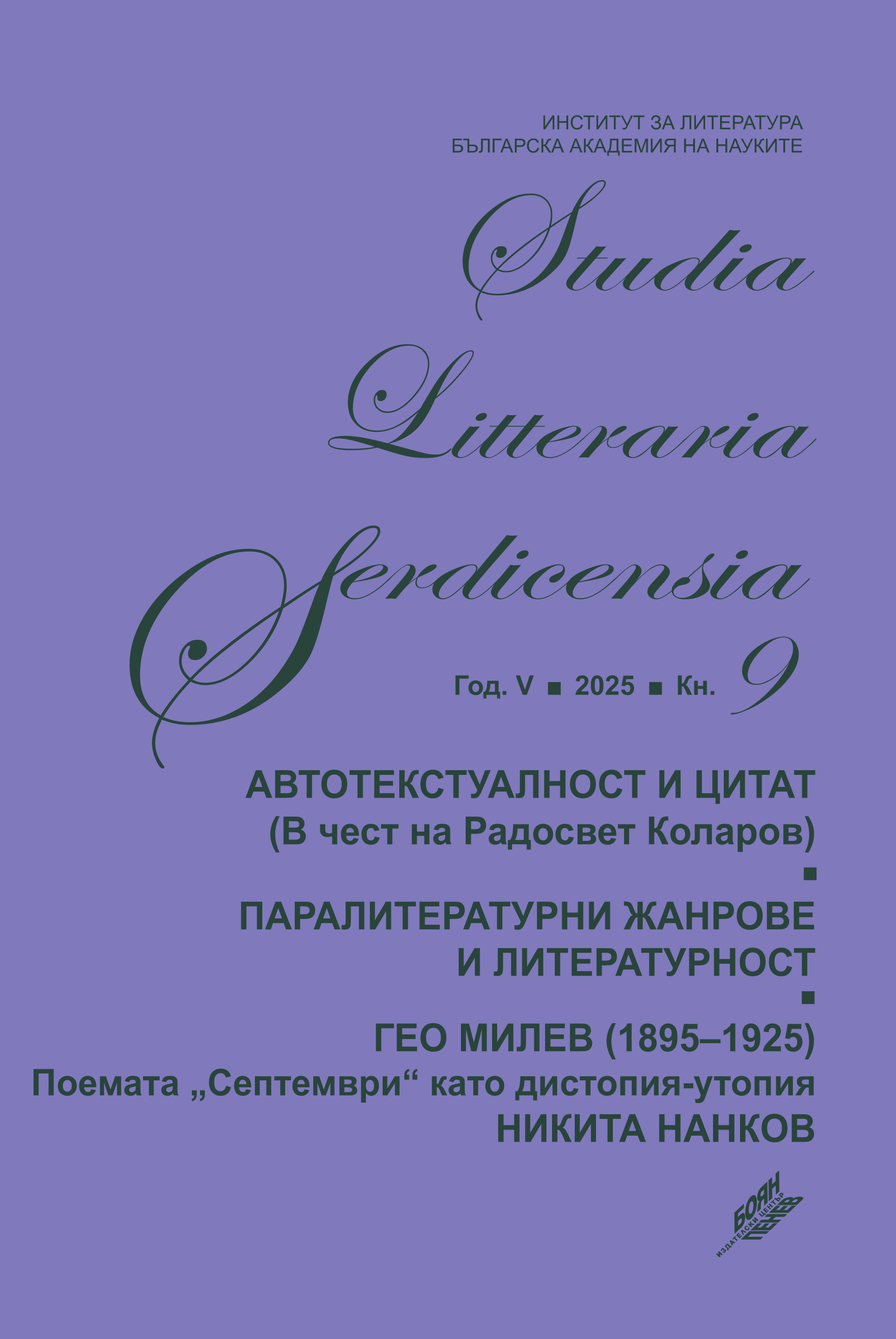
Autotextuality and Citation

(В чест на Радосвет Коларов)

12/04/2025

Nikolay Genov
Plamen Antov

INTRODUCTORY WORDS

  • ABSTRACT

    Основа на този брой на „Studia Litteraria Serdicensia“ съставляват студии и статии от последните два съвместни научни форума, организирани от секцията по теория на литературата на Института за литература – БАН и катедрата по теория на литературата в СУ „Св. Климент Охридски“. Става въпрос за Националната научна конференция „Автотекстуалност и цитат“ (2025) и Националната научна конференция „Паралитературни жанрове и литературност“ (2023), които представляват своеобразно продължение на една инициатива, отбелязала своето начало 13 години по-рано със събитието „Невидимата школа. Изплъзващият се предмет на литературознанието“ (2012). Оттогава двете звена – секцията и катедрата по теория на литературата – създават периодични събития, които целят да срещат изследователи в диалог върху проблемите на историята на българската литературна теория и нарастващото интердисциплинарно значение на литературоведските търсения. Примери за някои съвместни конференции от този тип са: „Просветителство срещу идеологема (Цветан Стоянов, Атанас Натев, Димитър Аврамов)“, състояла се през 2013 г., „Наследството на лингвистиката на българската теория“ през 2014 г., „Парачовешкото: Грация и гравитация. Двудневен форум в чест на проф. Миглена Николчина“ от 2015 г., както и форумите „Повторение, обновление – практики на римейка“ (2020) и „Кино, канон, готика: Двудневен форум в чест на доц. Огнян Ковачев“ (2021). 

    С представените материали в този том се надяваме да изразим признателността си към научната дейност на Радосвет Коларов, дългогодишен член на секцията по теория на литературата в ИЛ – БАН, и да провокираме интереса на академичната общност към темата за паралитературните жанрове и тяхното нарастващо значение за съвременното литературознание. 

    С третия дял отдаваме почит към двойния юбилей на Гео Милев (1895–1925), една от най-силните фигури в модернизацията на българската култура, но и – жертва на идеологическа свръхинтерпретация, затормозяваща и до днес рецепцията на творчеството му.


Autotextuality and Citation

12/04/2025

Hristo Hristov Todorov

METAPHONY AND AUTOTEXTUALITY: NOTES ON RADOSVET KOLAROV'S TERM FORMATION

  • ABSTRACT

    The paper examines two key terms in the theoretical works of the Bulgarian literary theorist Radosvet Kolarov — metaphony and autotextuality — in the immediate context of their emergence: Kolarov’s books Sound and Sense (1983) and Repetition and Creation (2009). Special attention is paid to the strategies that Kolarov follows in the process of term formation, as well as to the potential problems and limitations related to these strategies. Although Kolarov generally follows a morpheme-based minimalistic approach to his terminology, it often creates, intentionally or not, quite productive amphibolies that are helpful in charting some unstudied or neglected subfields of literary theory.


12/04/2025

Ventzeslav Scholtze, PhD

AUTOTEXTUALITY WITHOUT AN AUTHOR. THE THEORY OF AUTOTEXTUALITY AND THE EPISTEMOLOGICAL OBSTACLE OF AUTHORSHIP

  • ABSTRACT

    The paper’s aimed at elaborating and reinterpreting certain potentials of Radosvet Kolarov’s theory of autotextuality in order to revise the question of the relation between autotextual systems (idiolects) and difference, which has been mentioned and left unaddressed in “Repetition and Creation”. The paper researches the problematic of autotextual differences from the perspective of the question of the iterability of language constructs and its effects on the constitution and further interpretation of autotextual systems. Starting from that assumption, the text suggests a reading of Radosvet Kolarov’s theory as a specific deconstruction of authorship as an epistemological obstacle for the interpretation of texts framed by an author’s oeuvre.


12/04/2025

Margarita Serafimova

AUTHOR. ATMOSPHERE. AUTOTEXTUALITY

  • ABSTRACT

    On the terrain of psychology, the weather can activate involuntary memory and play the role of Proust’s madeleine. Identical meteorological circumstances are able to awaken the lost memory (“and then it was raining”). Thus memories seem to gush out of the picture of weather. The paper discusses some discursive strategies of the text (repetitions, variations, recurring motifs, disseminations) related to weather, as well as a number of more discrete intuitive or deliberate autotextual dominances and preferences for a particular season, type of weather or atmospheric phenomenon that form an invisible aura and lend a certain tonality to one’s work.


12/04/2025

Nadezhda Alexandrova

TIME, EPIGRAPH AND AUTOBIOGRAPHY: ON AUTOTEXTUALITY IN SOFRONIY VRACHANSKI

  • ABSTRACT

    The present paper deals with the autotextual potential of the codex “Book of Three Religions” written by Sofroniy Vrachanski in 1805. The main hypothesis, inspired by Radosvet Kolarov’s term “autotextuality”, is that the organization of the volume of three translated theological works on the Abrahamic religions and the original autobiography of the author correspond with a deliberately designed “epigraph”. The text of the “epigraph” is a maxim that can be regarded as a key for interpreting the whole logic of the volume. The maxim, which dates back to Antiquity coincides with Sofroniy’s idea of the different modes of time that define the role of humans as agents in global historic events.


12/04/2025

Nevena Mihova

REPETITION AND CREATION. PETKO R. SLAVEYKOV “HOW I BECAME BAGPIPER”

  • ABSTRACT

    The article focuses on the creative legitimation of P. R. Slaveykov upon the appearance of his first self-edited newspaper. The text interprets the intratextual mechanisms related to the development and testing of authorial roles, the multiplication of creative figures, and the construction of Slaveykov’s own personal myth in the context of the Bulgarian revival publicity. In this case, we are interested in the special emphasis on the creation of the writer as an unfinished act of initiation, enclosed in the multiplying iterative scheme of becoming.


12/04/2025

Kalin Mikhaylov

THE MOTIF OF DEATH IN THE POETICAL WORKS OF STOYAN MIHAYLOVSKI: WORLDVIEWS, INTERPRETATIVE CONTEXTS AND TRANSFORMATIONAL MECHANISMS

  • ABSTRACT

    The article considers the presence of the motif of death in the early and late poetical works of Stoyan Mihaylovski. Outlined as the main core facets of this motif, consistent in all of his works, are the general feeling of deadness associated with the death of ideals and grounds for social action in the world, and also with the perishing of all hope for the betterment of the human race; the universal scale of this calamity and the unsatisfying reasoning for “triumphant” evil in world history. The aforementioned aspects of the motif are viewed within the framework of a limited in scope whole, comprising the cycles “Doloroso” and “Varia”, from the most representative collection of Mihaylovski’s selected works to date – “Divine Rebel”, published in 1987. This makes it possible for two main and in many respects mutually exclusive world outlooks to collide and stand out, closely connected to the death motif, but oriented towards different horizons of meaning. The first one, stronger in the early Mihaylovski is the linear horizon fully contained in earthly human History with no way “upwards”, no way beyond. The second one, characteristic of the late Mihaylovski does not completely negate the first one, but integrates in itself the vertical transcendent dimension of being as well. The sonnet “Lama Sabahtani!” is seen as a key poetical work, marking the transition between the two. In the second part of the article, the death motif is viewed in a different interpretative context from the one in “Divine Rebel”. The analysis is focused on poems from another collection representative of Mihaylovski’s works, published in his lifetime and with his active participation – “Collected Works. Volume I”. The aim is to show the transformation in the death motif, using the autotextuality terms work of initiation, enhancing work and explicating work.


12/04/2025

Regina Koycheva, Asst. Prof. PhD

“THE SCOURGE OF GOD” SHORT STORY BY ELIN PELIN AND THE BIBLICAL TEXTS

  • ABSTRACT

    Elin Pelin’s first printed short story, “The Scourge of God” (1901), is a dialogue with the Bible that has not yet been the subject of independent research. The references to the Old and New Testaments in the text of the story have been discovered and analyzed in the present study. Subject of the research is how they participate in the message of the text, how they change and enrich the closed reading of the work. The analysis shows that Elin Pelin used in his own work primarily the eschatological biblical texts (to which the quote “Second Coming” at the end of the description of the drought refers) and the Book of Job (which, like the Bulgarian narrative, explores the causes of misfortune and examines the hypothesis of guilt from many sides). This result raises the question what Bible Elin Pelin read. For this purpose, certain passages of the story are compared with specific verses from the Holy Scriptures in three Slavic translations, which existed at the time of the writing of “The Scourge of God”. The comparison leads to the assumption that Elin Pelin most likely used the Russian Synodal translation of the Bible. The intertextual approach is combined with an analysis of the structure of the story. Duality is found to be the main structural principle according to which many components of the work (characters, attitudes, situations and plot events) are built. As the narrative unfolds sequentially, they split or double. The circumstances surrounding the creation of the work, as well as the spiritual convictions of the writer, are also examined.


12/04/2025

Bisera Dakova

IN THE WHIRlPOOL OF THE GAME OF QUOTES (OBSERVATIONS ON P. К. YAVOROV ATTEMPT AT FICTION, ENTITLED “FROM THE OBSERVATORY TO THE STATION”)

  • ABSTRACT

    Yavorov’s experiment to be not himself, to enter the zone of fiction, is a performative act: what we see on the road, on the move, crossing Sofia, coincides with the entry into and exit from the narrative (from the prose). In this compendium text, Yavorov, adopting a role uncharacteristic of him, continually refers to recognizable or hidden gestures of famous writers, demonstrating an ostentatious familiarity in handling them. There is an empathy with Luben-Caravelov’s “physiological sketch”, reminiscences from Aleko’s feuilletons, ironically snide remarks to P. P. Slaveykov, mockery at the poetry of Trifon Kunev. The narrative’s travelogue, the selected Sofia topoi are frankly reminiscent of Vazov’s cycle of stories “Kardashev on the Hunt”. Yavorov’s text abounds with quotations – from the mocking-parody of Nietzsche’s Zarathustra and the Gospel to the profane-volgarized belitrization of his own lyrical motifs, i.e. to the seemingly muted self-reference to already published.


12/04/2025

Silvia Nikolova

PLAYING THE LOVER'S DISCOURSE (A STUDY ON DILETTANTE AND “RUDENESS” BY CHAVDAR MUTAFOV)

  • ABSTRACT

    The article examines the ways in which the novel Dilettante (1926) and the short story “Rudeness” (1923) by Ch. Mutafov dialogize with each other through the problematics of the lover’s discourse. An attempt is made to illuminate the encounters and divergences between the two works on issues of inter-sexual relationships. The figure obscene by R. Barthes, drawn from his A Lover’s Discourse: Fragments, and the sociological concept plurality, proposed by the native art critic and essayist Kiril Krastev, play a significant role. The work is divided into three main parts. They correspond accordingly to the possibilities presented in Dilettante, which organize the book purely formally, but also conceptually, and through which we can think of one or another text as a work-amplifier or a work-explicator for another (according to R. Kolarov’s theory).


12/04/2025

Samuil Radilov

COLLAPSE AND INTEGRATION OF THE EPIC FORM IN THE ORDINARY PEOPLE BY GEORGI KARASLAVOV

  • ABSTRACT

    The paper aims to reveal the mechanisms of discursive disintegration in Georgi Karaslavov’s novel The Ordinary people (Obiknoveni hora, 1952–1975). According to the proposed thesis, the novel's ideological and compositional disorder is not an accidental example of the inapplicability of the social-realist method, but is due to the peculiar relationship between the individual features of the creative process and the demands of epic form as understood by the early György Lukacs. The methodological stake of this soldering is Radosvet Kolarov's concept of matrix and repetition functioning at the level of autotextuality. According to the thesis argued for here, the textual matrix that encompasses Karaslavov's work consists of two guiding principles that come into different relations according to the specific text: the principle of the documentary thought of as a marginal artistic objectivism, and the principle of the epic, thought of as an ideological treatment of the lived material. Hence the peculiarity of the epic form in the novel The Obiknoveni hora is interpreted as the result of the hypertrophy of the principle of the documentary, which seizes and thereby degenerates the epic functionality. The examples of discursive dissonance discussed serve to exemplify the consequences of the disintegration of epic form and the mechanisms of its reintegration within a post-epic structure.


12/04/2025

Plamen Antov

AUTOTEXTUALITY IN RADICKOV’S FICTION

  • ABSTRACT

    Initially, the article brings together two areas. The first is thematic: attention is paid to some, albeit discreet, glimpses of current, topical, acutely political issues in Radichkov’s fiction prose from the 1960s–1970s. But even more important is the second – the poetic one: the techniques through which the political theme enters the narrative. It is here that the concept of autotextuality is introduced as a key operational concept. From here on, we proceed to examine the ways in which it operates in Radichkov’s prose. Two such forms are examined – of a folkloric and a specifically literary type, with the emphasis on the latter. The “soft”, veiled, elusive subversion of this technique is examined on a two-fold level: first, in relation to the ideological norms of the era, and second – in relation to literary (linguistic) norms.


12/04/2025

Ivan Georgiev

AUTOTEXTUAL LEITMOTIF TECHNIQUE. FEW ESSAYS BY THOMAS MANN (AND “DOKTOR FAUSTUS”)

  • ABSTRACT

    Thomas Mann is one of the most prominent autotextual authors who himself has commented on the key role of the leitmotif for his own work. According to the main thesis of this article, the connections between his texts is determined by a peculiar autotextual leitmotif technique. The paper elucidates what autotextual leitmotifs are and in what ways their development connects different texts of the author. The paper problematizes the boundaries between fiction and essay (in particular between the novel and the essay) of Thomas Mann through two examples of autotextual leitmotifs, the core of which is oriented towards the author's key problem of the relationship between genius and disease.


12/04/2025

Yoanna Yaneva

THE REPERTOIRE AS A KIND OF REPETITION: AUTOCITATIVITY AND MEMORY IN “Waiting for Godot” BY S. BECKETT

  • ABSTRACT

    The article examines Samuel Beckett’s absurdist drama “Waiting for Godot” through the lens of autocitation, repetition, and shifting context. Drawing on Jacques Derrida’s notions of the instability of meaning and context, as well as Radosvet Kolarov’s concept the analysis emphasizes the absence of internal memory within the fictional text itself. The first and second acts are approached as autonomous yet mutually reflective textual units, connected not through logical continuity but through rhythmic repetition with variation. This structural pattern evokes a sense of circularity and stasis. The transformations observed in the characters of Pozzo and Lucky are interpreted as metatextual gestures that undermine the linear progression of events. Meanwhile, through the erasure of memory and the constant recurrence of identical actions, Vladimir and Estragon appear trapped within the closed boundaries of a chronotope of waiting. In this way, the play presents memory not as a source of meaning, but as a mechanism of deferral.


12/04/2025

Gergana Galabova

MISE EN ABYME AND RECCURSION IN THE HEARING TRUMPET GY LEONORA CARRINGTON

  • ABSTRACT

    This article analyses Leonora Carrington’s novel The Hearing Trumpet through the lenses of autotextuality, mise en abyme, and recursion. Inspired by the poetics of Radosvet Kolarov, the study traces how recurring visual and narrative elements construct a self-reflexive structure in which each new meaning emerges through the transformation of already familiar motifs. Mise en abyme functions not only as a device for embedding a story within a story, but also as a mechanism for unsettling the boundaries between different layers of the text, while recursive structures generate a fractal sense of a world that continuously creates itself. In this context, The Hearing Trumpet is approached as a microcosm of Carrington’s broader autotextual practice, evident across both her literary and visual works. The study argues that repetition in Carrington’s oeuvre is not mechanical but productive—a form of discursive desire through which texts unfold new meanings and interrelations.


12/04/2025

Stefan Goncharov

THE TRANSMODAL CUT IN THE WORK OF J. G. BALLARD

  • ABSTRACT

    This article offers a speculative, autotextual reading of J. G. Ballard’s oeuvre through the lens of psychoanalysis and the theoretical framework of Radosvet Kolarov. It seeks to develop the concept of “auto-catastrophe” – a traumatic event that marks a radical turning point in an author’s creative output. The study conceptualizes this auto-catastrophe as a “transmodal cut” that (dis)connects various techniques, motifs, media, corpora, etc. The text also proposes a reading of Kolarov’s notion of “discursive desire,” interpreted through Jacques Lacan’s psychoanalytic concept of enjoyment [jouissance].
    The article applies these concepts in an analysis of Ballard’s most experimental work, The Atrocity Exhibition, emphasizing its intermedial aspects in order to demonstrate how the transgressive nature of the transmodal cut enables literature to cross its own formal boundaries. The text also explores how the auto-catastrophe can (dis)connect the works and enjoyments of different authors who share the same trauma. To this end, it briefly examines the relationship between the works of Ballard and those of the American writer William Burroughs.


12/04/2025

Yakim Petrov

FINISHING WILLIAM BURROUGHS: THE ETHICS OF THEFT AND THE GESTURE OF THE JOKE

  • ABSTRACT

    The article “Finishing William Burroughs: The Ethics of Theft and the Gesture of the Joke” seeks to reconsider the legacy of the Burroughsian corpus of experimental texts (novels, essays, manifestos) by proposing a new trajectory focused on the conceptual and ethical stakes found in the work of the cult American author. Working in the space between the writer’s biographical trauma (the accidental shooting of his wife during a game) and the logic of Burroughs’ own texts, the article offers an entry point into his method and the specific ethics of a writing that exceeds the control of language. This writing may be defined as a speculative radicalization of the problem of (self-)citation, articulated through the notions of conceptual theft and the joke as a gesture of the cut.

    The analysis of these techniques is carried out through a reading of Queer and its 2024 film adaptation by Italian director Luca Guadagnino. Presenting the unfinished second novel Queer as an initiaton work (in the sense developed by Radosvet Kolarov), the text reveals the play of a “citation of the Real” (the shooting), exposed through Guadagnino’s cinematic rendering. In unfolding the wager of this key Burroughsian remainder, the article turns to its central object of inquiry— the logic of theft and the gesture of a joke. These are linked to the methods of cutting and folding (cut-up and fold-in), which secured Burroughs’ cult status in postwar Western literature. 

    The latter are theorized through late Lacanian psychoanalysis (the symptom) and Deleuzian concepts such as the body without organs (BwO) and his notion of humor. Through the attempt at a singular synthesis of these trajectories in Burroughs, the article reveals the ambivalent (political, psychosocial, and ethical) experiment of writing yourself out of language conceived as a totalizing system of control. 

    Furthermore, besides functioning as an introduction to the Burroughsian ethics of resistance to language via theft and humour, the article aims to serve as a speculative tracing of possible connections between Burroughs’ writing practice and some pressing contemporary issues. These include the problems of informational (digital) control societies, the logic of large language models (LLMs), the consumption of nonsense content (“brainrot”), the institutionalization of paranoia, and of conspiratorial reason. These are the contemporary stakes that define the article’s experiment with the Burroughsian ethos.

    Finally, beyond theorizing theft and the joke as a speculative approach to writing and ethics, “Finishing Burroughs…” also performs a brief demonstration. It applies the Burroughsian disposition to the local context of Russian propaganda, disinformation, and nationalist (patriotard) ideology.


12/04/2025

Alexander Popov

ARTIFICIAL INTELLIGENCE AS AN AUTOTEXTUAL PROCESS

  • ABSTRACT

    The Article presents a close reading of the movie “Her” (2013), directed by Spike Jonze. In that reading the artificial intelligence in the movie is modeled via the theoretical apparatus of Radosvet Kolarov introduced in his book Repetition and Creation: Poetics of Autotextuality. Twelve years after the premiere of the movie, the operating system Samantha seems like a plausible extension of current large language models, bearing in mind her full dependence on the human-derived textual data on which she has been trained. “Her”, however, goes beyond the mechanical extrapolation that artificial intelligence is going to get ever faster, more precise and defter at the manipulation of language, as it is used by people. The operating systems in the movie gradually converge on the position of being simultaneously readers, authors, editors and critics of the full corpus of texts, and perhaps ultimately achieve the virtual being of the idea, which in Kolarov’s work is tied to the concept of “matrix”, i.e. a virtual invariant of the idea that determines the autotextual transformations within the oeuvre of a given author. The artificial intelligences in “Her” implicitly work with the whole of humanity as a corpus and in this way they dynamize the boundaries between work and oeuvre, person and world, individual and archetype, body and mind, as well as other ontological binaries. Following Kolarov, the article attempts to explicitly reconstruct this model for the development of artificial intelligence, which is hidden in the movie. That model perhaps should be seen not so much as a speculative attempt at prediction, but as the hyperintensification of a phenomenology of text which is already deeply implicated in the present.