
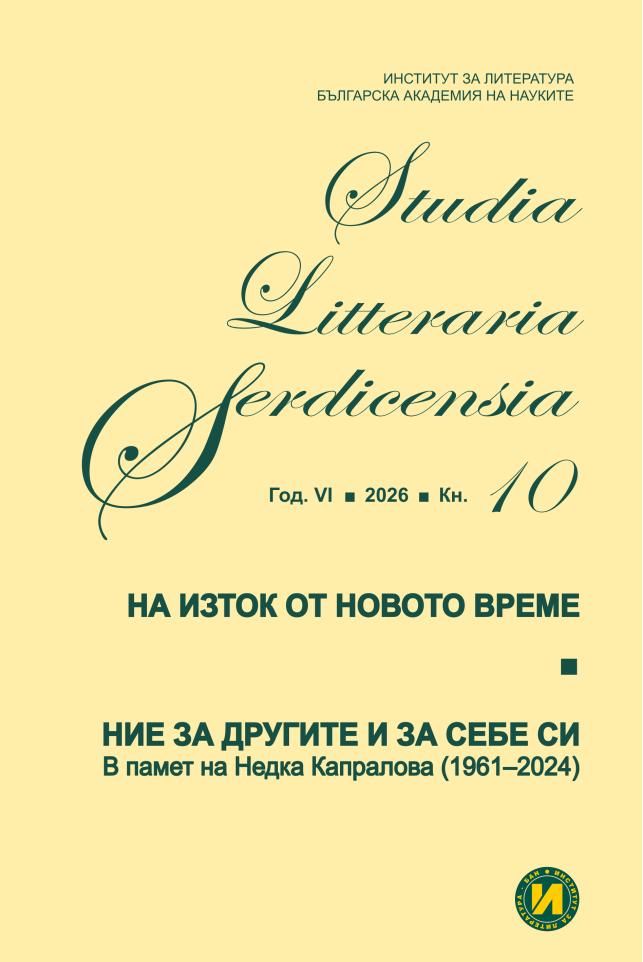
Book 10
-
PUBLISHING HOUSEInstitute for Literature - BAS
-
Online-ISSN2815-2999
-
Print ISSN2738-7631
-
SUBJECTHistory, Philosophy, Social Sciences, Language and Literature Studies, Literary Texts
-
Page count347
-
STATUSАктивен
•
PDF
TITLE PAGE
-
Abstract
Subject: We for Others and for Ourselves, East of the New AgeKeywords: TITLE PAGE
На изток от Новото време
•
PDF
“THEY SAY THAT THE TSAR IS NOT REAL!” RUSSIAN PROJECTIONS OF THE STORY OF THE REPLACED TSAR
-
ABSTRACT
Narratives questioning the ruler’s authenticity have existed since time immemorial—both as an effective weapon in political struggle and as an outlet for deep social anxieties. The tsar’s inauthenticity has two main forms: active (impostorism) and passive (the substitution of certain people or forces for the real one). The study focuses on Russian projections of the tsar-substitute narrative. It manifested itself most clearly and fully in relation to Emperor Peter the Great, the builder of modern Russian statehood. An analysis of the factual material revealed that it is more appropriate to speak not of a single plot, but of a more complex structure—a megaplot. Many of its elements emerged simultaneously at the turn of the 17th and 18th centuries, and from then until today, they have remained in a state of dynamic interweaving, mutual complementarity, and development. Some of them have acquired autonomy (miraculous rescue, the arrival of a savior), while others have narrowed to the level of motif (the shape-shifter). The mega-plot about the replaced ruler is built on two components, which can be roughly defined as realistic and mystical. The core of the realistic com- ponent is the replacement of the tsar (at a genetic level, in childhood, abroad) by certain very specific individuals, which is conceived as an actual event. The mystical plot threads are connected through the profound archetypes of the Double and the Changeling, which, by activating the age-old fears of the Shape-shifter—half-man, half-beast—introduce the apoca- lyptic Beast into the collective consciousness of the Petrine era. Along- side him, other aspects of the Antichrist are also realized—the God-fighter and false Christ, whose visualization in opposition circles is Peter the Great. The plots created during this crucial era proved exceptionally effective, leading to their use on the emperor’s political heirs. The mystical element remained in the public debates of the past, but resonated in Russian literature (the works of A. S. Pushkin and D. S. Merezhkovsky). Realistic element, on the contrary, is increasingly present today thanks to digital technology. The sensational plot of a ruler being replaced, complemented by spinoffs of miraculous rescues and the redeemer of royal blood, draws more and more new faces into its orbit.
Subject: East of the New AgeKeywords: substitution replacement double changeling Antichrist Peter the Great
•
PDF
PETER THE GREAT PRUT’S CAMPAIGN AND THE APPEARANCE OF THE RUSSIAN TRANSLATION OF THE SLAVIC KINGDOM BY MAVRO ORBINI
-
ABSTRACT
The article discusses the Russian translation of The Slavic King- dom by Mavro Orbini, published in Moscow at the initiative of Peter the Great. He takes a particular interest in the Southern Slavs during the campaign of 1711 to river Prut, hoping to raise them to fight against the Ottoman enslavers. The campaign is failed, but on the tsar’s order Sava of Ragusa (Dubrovnik) translates the above-mentioned work of Orbini. Attention in the article is given both to the personality of the translator and to his translation techniques. In the process of translation Sava of Ragusa omits many parts of the Italian original text in view of the interests of Russian readers. The Bulgarian share of the The Slavic Kingdom and the reasons for the translation’s gaps are analyzed in more details. An attempt to classify the omissions is made.
Subject: East of the New AgeKeywords: The Slavic Kingdom by M. Orbini MAVRO ORBINI Sava of Ragusa Russian translation Bulgarian
•
PDF
IN MEMORIAM
Igor Kaliganov 1946 – 2025
-
ABSTRACT
През 2025 г. – в навечерието на своята 80-годишнина – вдъхновеният българист и изследовател на историята на славянските и балканските литератури Игор Калиганов напусна този свят. Оценен високо не само в славистиката, но с приносите си в европейското културно пространство, през 1997 г. той бе удостоен с премията в памет на митрополит Макарий (1482–1563), а през 2006 – с Международната премия „Св. св. Кирил и Методий“. Дейността му като българист бе отличена с почетни грамоти от Министерството на културата на Република България (1994 и 2000), с почетните знаци на БАН и на Руската православна църква, както и с най-високото българско държавно отличие – орден „Стара планина“ I степен (2000) за цялостно творчество.
Subject: East of the New AgeKeywords: Игор Калиганов
•
PDF
THE “TEXTUAL” BAY GANYU AND HIS ILLUSTRATIVE IMAGES, OR WHERE DID THE BELGIAN ROOM, THE VIENNA REDINGOT AND THE PALACE FRACTURE DONE?
-
ABSTRACT
The article starts from the discrepancy between the visual image of Bai Ganyo imposed by Bulgarian artists and the descriptions of the character in the text of the work, in order to ask the question of what is the model on which the book is built. Is this the model of realistic literature, as the work is usually read, or is it some other? The distinction introduced by Sergey Averintsev between the models of ancient Greek literature and Near Eastern literature has been used to defend the thesis that Bai Ganyu exhibits all the basic signs of literature. The main characteristics of this model are: the allegorical poetics of the parable, not of ekphrasis; the involvement of the word directly in life situations; indexical, rather than iconic, function of verbal descriptions of the visual; the fundamental incompleteness of the work; manifestation of the personages as “ethos” rather than “characters”; functioning of the work as part of a ritual, in which its social function is realized through direct instruction. The analysis of the book in accordance with this model concludes that the allegorical meanings of the two main problematic concepts in it – “European” and “Bai Ganyu” – are different in the first and second parts. Thus, the question arises about the genre of the work, which also determines its place in life – way of perception, cultivated patterns of behavior and social function. The thesis that Bai Ganyu – Incredible Stories of a Modern Bulgarian is a novel has been disputed, and it has been stated that the book is a cycle of stories built on the paradoxical combination of the models of parable and anecdote, and its entirety is organized 100not around a single story, as would happen in a novel, but around the main problem that the book poses. The problem of the difficult transition of Bulgaria and Bulgarians to the conditions, values, lifestyle and social rules of modernity.
Subject: East of the New AgeKeywords: traditionalism modernity narration cultural function wordliness literature genre
•
PDF
THE SVISHTOV ADVENTURE OF 1867 AND MIDHAT PASHA: THE STORY OF A BETRAYAL, PUNISHMENT AND REPENTANCE WITH MANY TEACHINGS
-
ABSTRACT
Midhat Pasha, the Governor-General of the Danube Vilayet, managed to unravel the complex knot of the Svishtov Adventure of May 1867 thanks to the betrayal of Yordan Gergitsov, who was one of the main organizers. Several dozens of young people from Svishtov, who were sentenced to exile in Diyarbakir, were pardoned prematurely with the decisive intercession of the Grand Vizier Midhat Pasha. In the proposed text, the Svishtov Adventure is viewed as a story full of lessons and teachings about betrayal, punishment and storytelling.
Subject: East of the New AgeKeywords: Danube Vilayet Svishtov Adventure Midhat Pasha Yordan Gergitsov Diyarbakir exiles repentance
•
PDF
FAITH – THE BASIS OF UPBRINGING IN PETKO SLAVEIKOV’S “PCHELITSA”
-
ABSTRACT
The study deals with the educational and religious elements of Petko Slaveikov’s Revival children’s magazine “Pchelitsa”. Their presence is conditioned by the author’s views on the role of the child in social construction and the need to integrate them into Christianity. The text aims to highlight the guiding principles in the creation of the faith related publications. Several main themes are identified, united by Christian themes. These are God, duty to others, abstract concepts, Holy Scripture, the prayer, and the man.
Subject: East of the New AgeKeywords: Petko Slaveykov “Pchelitsa” magazine religious education children’s periodicals Christian faith
We for Others and for Ourselves
•
PDF
We for Others and for Ourselves
In memory of Nedka Kapralova (1961–2024)
-
ABSTRACT
Настоящият дял на „Studia Litteraria Serdicensia“ събира изследователските приноси от проведения през месец април 2025 година ХХIХ Колегиум по възрожденска литература на тема „Ние за другите и ние за нас“, посветен на светлата памет на доц. д-р Недка Капралова – ръководител на секция „Литература на Българското възраждане“ (2020–2024) и дългогодишен ревностен изследовател на възрожденските процеси. Недка Капралова беше основен организатор на този колегиум, който не успя да се състои в планираното време през 2024 г. поради нейната неочаквана кончина. Проведен със закъснение от една година, форумът се превърна в акт на научна приемственост и почит към паметта и изследователския труд на доц. Капралова.
Subject: We for Others and for OurselvesKeywords: memory
•
PDF
WE, THE ENLIGHTENED
(От „О, неразумни и юроде“ до „Знаеш ли ти кои сме?“)
-
ABSTRACT
This article examines one of the main research projects of Nedka Kapralova, namely, the practice of sponsorship during the Bulgarian National Revival and its importance for understanding the processes that accompanied the transition to modernity in the Bulgarian lands. The new historical era gave rise to new social actors. Literature would begin to “produce” those actors and circulate them as cultural models. The Enlightened European, the National Awakener, and the Teacher became symbolic images charged with the notions of a new and desired cultural space. These figures had their antipodes: the Phanariot and the Pseudo-Civilizer, both rooted in the enemy aggressor stereotype. The collective self-envisioned images of “We, the Bulgarians” and “We, the Enlightened Bulgarians” were gradually affirmed by being juxtaposed with, and contrasted against, the above-mentioned antipodes. The phenomenon of sponsorship, as analyzed by Kapralova, reveals the mechanisms through which new normative frameworks were established. It highlights notable cases in the legitimization of an emergent modern culture, with its guilds and its respective new social networks and circles. The study further attests to the mentoring ethos of the men of letters and offers intriguing insights into the self-determination of the Enlightened. Another line that is traced is represented by the shifts in attitudes and moral orientations of successive generations of intellectuals of the Revival period.
Subject: We for Others and for OurselvesKeywords: Bulgarian Revival period Enlightenment sponsorship intelligentsia Nedka Kapralova
•
PDF
BETWEEN CURIOSITY AND INTOLERANCE: BULGARIAN ATTITUDES TOWARDS AMERICAN MISSIONARY EDUCATORS
-
ABSTRACT
Thе article examines Bulgarian responses to American missionary edu- cators in the Ottoman Balkans during the nineteenth century, tracing a spectrum that ranges from curiosity and engagement to suspicion and intolerance. It ex- plores how Protestant ideas and cultural ideals intersected with Bulgarian literary and spiritual life, education, and the activities of educators and church figures. The reception of missionaries’ work — both favourable and highly critical — is documented in the literature, in periodicals, pamphlets and brochures, as well as in personal correspondence. The article also considers how interpretations of missionary contributions shifted over time, with broader reassessments emerging more than a century after the official beginning of their work among Bulgarians.
Subject: We for Others and for OurselvesKeywords: American missionaries Bulgarian Revival period literature education periodical press
•
PDF
KARAVELOV AND THE SLAV ON THE PAGES OF THE NEWSPAPER “SVO- BODA”
-
ABSTRACT
The first issue of the newspaper “Svoboda” marks a new stage in the journalistic activity of the Bulgarian revolutionary Lyuben Karavelov. The experience that he gained by publishing papers in different Russian and Serbian jour- nals brings him to the next logical step – his own independent journalism, aimed mainly at the Bulgarian readers in their own language. The research concentrates on how the different Slavic peoples and the Slavs as a whole are presented, what ideas for their unification are articulated – cultural, or political, or if there is some combined model. The way those ideas of the revolutionary change over time is also followed, be it during his stay in Russia or in the Serbian Principality later on.
Subject: We for Others and for OurselvesKeywords: political project Slavs freedom federation
•
PDF
RHETORICS OF THE REGIONALITY IN BULGARIAN NATIONAL REVIVAL POETRY
-
ABSTRACT
In the 19th century Bulgarian poetry, two contradictory tendenc- es could be outlined. The first one is represented by intensified interest in fo- reign cultures and cultural models. The second one is driven by the idea of national self-preservation. The term “regional” refers to a limited scope of nationally-centered uses. They are based on the locality, nationality, Balkan and Oriental identities, regarded in an essentialist approach, and function as a protective framework of belonging to a group. These spheres were deliberately distinguished from the broader European context and, even more so, from the notion of the universality, which remained influential in Western intellectual discourse at the time. The paper also examines the dynamics of regional discourse, tracing its development from local to national levels, and the strategies through which the Bulgarian identity was legitimized through language, cultural heritage narratives, and certain Occidentalist attitudes.
Subject: We for Others and for OurselvesKeywords: Bulgarian Revival period poetry rhetorics of the regionality identity Occidentalism
•
PDF
CRITICAL REMARCS ON THE CONCEPT OF THE ODESA LITERARY CIRCLE
-
ABSTRACT
The text sets forth a critique of the concept of the Odesa Literary Circle, which has been widely employed in studies of the Bulgarian National Revival literature to typologically characterise the intellectual life of Bulgarians studying in Odesa during the 1840s. It reexamines the literary careers of Dimitar Mutev, Elena Muteva, Nayden Gerov and Dobri Chintulov and suggests that there is insufficient factual evidence to substantiate the relevance of the two main components underlying this concept: organised literary life and literariness.
Subject: We for Others and for OurselvesKeywords: Odesa Literary Circle Dimitar Mutev Elena Muteva Nayden Gerov Dr. Krastev Dobri Chintulov
•
PDF
WE OR WE (NIY ILI NIE) IN THE NEWSPAPER “SHUTOSH”: BOUNDARIES OF THE COLLECTIVE IDENTITY
-
ABSTRACT
The paper examines the use of niy/nie (we/we – on different stylis- tic levels of language) in Bulgarian National Revival literature as a means of constructing a journalistic voice and conferring representativeness on expres- sion in the press. The study is grounded in the satirical text “Niy ili nie” (“We or We” – on different stylistic levels) by Petko R. Slaveykov, published in the newspaper Shutosh in 1874, in order to trace how National Revival intellec- tuals constructed the categories of we and the others within the framework of the Bulgarian cultural community. The analysis focuses on stereotypes and the rhetorical strategies employed by these intellectuals to legitimize their place in the public and political discourse. Particular attention is paid to the role of the collective we in the Bulgarian press, with the aim of addressing the following question: to what extent does the language of the Revival function as a means of self-affirmation in opposition to external cultural influences and internal social tensions? The rhetorical functioning of niy and nie extends beyond the level of linguistic choice and emerges as a means of constructing a journalistic stance and conferring representativeness on expression in the Revival press.
Subject: We for Others and for OurselvesKeywords: Bulgarian Revival journalism Shutosh newspaper Petko R. Slaveykov Marko Balabanov satirical commentary
•
PDF
TWO FORGOTTEN MANUSCRIPT COLLECTIONS OWNED BY TWO ANTI- QUARIANS FROM VRATZA AND LOVECH
-
ABSTRACT
This article attempts to reconstruct (partially) the composition of the manu- script collections owned by Todoraki Hadzhitoshev from Vratza (the manuscripts received at the National Library “St. Cyril and Methodius”) and Mihail Hadzhinedelchev, which is part of the collection of the Regional Museum of History – Lovech.
Subject: We for Others and for OurselvesKeywords: Todoraki Hadzhitoshev Mihail Hadzhinedelchev manuscript collections
•
PDF
THE PUBLISHER AVERKIY POPSTOYANOV AND HIS SPONSORS
(Based on material from the old printed book Vita of Archbishop Grigory of Omirit, Belgrade, 1852)
-
ABSTRACT
The article presents the Bulgarian old printed edition – Life of Grigoriy Omiritski, prepared by Averkiy Popstoyanov, abbot of the Osogovo Monastery “St. Joachim Osogovski,” and remaining the only one in the National Revival printing tradition. The funds for the printing of the book were collected by supporters from the entire Bulgarian ethnic territory. Among them are National Revival teachers, clergymen, monks, writers, who became in the fol- lowing years some of the famous figures of the Bulgarian National Revival.
Subject: We for Others and for OurselvesKeywords: Rila Monastery vita Announcements for Bulgarian old printed books Bulgarian old printed book contributors
•
PDF
TAMING GEORGE SAND, OR ON THE SELECTIVE RECEPTION OF EURO- PEAN MODERNITY DURING THE BULGARIAN NATIONAL REVIVAL
-
ABSTRACT
The present article examines the reception of George Sand in Bulgarian Revival culture, considering it as a process of selective appropriation of Eu- ropean modernity. The main thesis is that nineteenth-century Bulgarian society did not adopt Sand’s work directly or in its entirety, but rather “domesticated” it by adapting it to its own moral and ideological norms. The study draws on 270reception aesthetics (Jauss, Iser), the theory of translation as rewriting (Lefevere), cultural transfer theory, and polysystem theory in order to demonstrate that translation functions as an active mechanism of filtering and rearranging foreign texts. In this context, Bulgarian translators act as cultural mediators who select and adapt Sand’s works according to the “horizon of expectations” of the National Revival reader. The analysis shows that predominantly moralizing and pastoral works entered the Bulgarian cultural milieu, while the more radical novels addressing issues of female autonomy, sexuality, and the critique of marriage remained outside the translated corpus. This selective appropriation transforms Sand’s image from that of a socially critical emancipatory writer into a “safe” moralist, compatible with the patriarchal values of Revival society. At the same time, her translations perform an important cultural function: they introduce new aesthetic models, romantic motifs, and social sensibilities, while contributing to the formation of the national literary system. The reception of George Sand in the Bulgarian National Revival is thus strictly selective and adaptive, admitting only those elements of European modernity that can be in- tegrated into the local moral and cultural context. This process reveals a broader mechanism of cultural mediation, whereby modernity is appropriated not as a direct transfer but as a transformed and ideologically refracted phenomenon.
Subject: We for Others and for OurselvesKeywords: George Sand Bulgarian Revival period reception translated literature cultural transfer
•
PDF
DO WOMEN HAVE FREE WILL?
(FEMALE CHARACTERS IN TODOR PEEV’S DRAMA “FUDULESCU”)
-
ABSTRACT
Todor Peev’s drama draws attention to the status of women in the revival family and unfolds the various patterns of acceptance, rejection or accommodation to its norms. Social changes in the transition from traditional to pseudo-modern social roles are articulated as a moral and ethical problem. The female protagonist is a young girl set out on the path of “becoming civilized,” she is the agent of social dynamics. Becoming an adult, she attempts to ground her understanding of a woman’s place in the world on the category of free will, but finds out that “the new theories” are a subject of irony. The violation of established relationships and the pursuit of fashionable bookish models turn her life into tragedy. With the proposed theme, I aim to examine the personal story of this character and that of the other female figures in the play. I relate their behavior and mentality to Fudulescu’s “new doctrine of limitless personal freedom.” Are women free in their choices, or they are the helpless prey of false ideas and remain dependent on the manipulator’s persuasions? What are their tactics for coping with the imposed authority and male dominance and what are their existentially important goals?
Subject: We for Others and for OurselvesKeywords: female characters becoming civilized free will Fudulescu
•
PDF
“WHERE DOES LOVE COME FROM?” SLAVEYKOV’S PHILOSOPHICAL AND IRONIC GENERALIZATIONS ON MARRIAGE
-
ABSTRACT
This paper focuses on the reflections of the National Revival poet P. R. Slaveykov concerning falling in love and the nature of love. It traces the meta- morphoses of infatuation and the foundations that establish the new family unit from the perspective of three mutually exclusive worldviews, which compete 290with each other within the Bulgarian sociocultural space, neutralizing the traditional model as a regulator of family planning. Slaveykov’s insights reflect a civilizational curve entering the difficult to control zone of emotional charge and social coercion. He follows a reverse trajectory: from feelings of shame and awkwardness, through the unleashing of instincts, to the pragmatic logic of the marriage market, which transforms love into an economic transaction
Subject: We for Others and for OurselvesKeywords: P. R. Slaveykov Bulgarian Revival period love sociocultural paradigms family planning
•
PDF
THE ARTICLES OF EKATERINA VASILEVA, OR THE COURAGE OF “A BULGARIAN WOMAN FROM BRAILA, K. M. V.”
-
ABSTRACT
The paper explores the origin and content of five articles sent by Ekaterina Vasileva, a revivalist intellectual with an interesting and unusual personal biography, to the newspapers Otechestvo and Turtsiya. Her publica- tions are among the rare public appearances of a female voice in the public sphere during the Bulgarian Revival period. This required courage, and Ekate- rina Vasileva demonstrated it. In several publications, she expressed her opini- on on public matters and joined in one of the heated theatrical debates that erupted around the performance in Braila of “Velisava, Bulgariann Princess” by Dobri Voynikov. Nedka Kapralova’s book Ekaterina Vasileva. Spomeni. Sti- hotvoreniya. Dopiski gives the reader a much more complete and comprehen- sive picture of the author, who transcends the limitations of her environment.
Subject: We for Others and for OurselvesKeywords: Ekaterina Vasileva articles revivalist newspapers female voice Nedka Kapralova
•
PDF
ABOUT THE BOOK EKATERINA VASILEVA. MEMOIRS. POEMS. REPORTS
-
ABSTRACT
The article reveals the significance of Nedka Kapralova as a scientist with contributions to the Bulgarian literary history. The emphasis is upon her research related to her book Ekaterina Vasileva. Memoirs. Lyrics. Reports (2022). That book has a fundamental importance for future researchers.
Subject: We for Others and for OurselvesKeywords: Nedka Kapralova Ekaterina Vasileva literary history source studies
•
PDF
PROFESSIONAL AND PERSONAL REFLECTIONS ON NEDKA KAPRALOVA
-
ABSTRACT
The text interweaves personal memories of Assoc. Prof. Nedka Kapralova, PhD, with a presentation of her most significant literary contributions to the field of the Bulgarian National Revival. The paradoxical connections between various themes, figures, and works outlined in her research is traced here to present sketches of the colorful and multifaceted image of the National Revival period, as well as the importance of her numerous translations – some of them foundational for Bulgarian literary studies and culture.
Subject: We for Others and for OurselvesKeywords: Bulgarian Revival period archives memories women authors translations
•
PDF
THE RESEARCH IMAGE OF NEDKA KAPRALOVA IN THE FIELD OF RENAISSANCE CULTURE
-
ABSTRACT
The article traces how Assoc. Prof. Dr. Nedka Kapralova became one of the prominent researchers of culture and literature of the Bulgarian Revival. Having left us untimely, she did not realize her ideas, did not fulfill her research dreams. Her research is primarily in the field of Revival culture, with her scientific interests mostly focused on the phenomenon of philanthropy. She is interested in the connection between folklore and literature, researches female initiation as a phenomenon, etc. The topic of philanthropy is her doctoral thesis. She treats the facts and the documents with respect, which is evident in her book dedicated to the letters of Elisaveta Karaminkova. Over the years, she has been involved in various projects, the result of which is her latest book, dedica- ted to Ekaterina Vasileva. She bequeathed to the Bulgarian cultural community some precise translations of modern French scholars, cultural theorists and philosophers such as Claude Lévi-Strauss, Fernand Braudel and Pierre Bourdieu.
Subject: We for Others and for OurselvesKeywords: Nedka Kapralova Bulgarian Revival period sponsorship female initiation
•
PDF
BIBLIOGRAPHY of Assoc. Prof. PhD Nedka Kapralova
-
Abstract
Subject: We for Others and for OurselvesKeywords: Bibliography
Рецензия
•
PDF
BOTEV: REFRACTORING IDEOLOGICAL MODELS
(Anna Alexieva. Hristo Botev: Ideological Modeling of the Heroic Image)
-
ABSTRACT
Книгата на Анна Алексиева „Христо Ботев: Идеологическо моделиране на героичния образ“ е книга за нацията и нейната не особено дълга история – от 1848 година до днес. Книга, която разкрива колебанията на идеологическото махало, чиято амплитуда се определя от силата на отделните социално-визионерски проекти през годините. И четена по този начин, книгата на Анна Алексиева разгръща един цялостен и дълбинен разказ за културната история на българската нация. Изследването задава много въпроси за това кой е Христо Ботев. При това авторката ги задава и на големите езикови модели ChatGPT и BgGPT в усилията си да свери собствената си аналитична точка с машинната. „Ще призная, че ми се иска българският изкуствен интелект да не е отражение на „естествения“, споделя Анна Алексиева с лека ирония наблюдението си, съдържащо драматична сериозност. Авторката има право на тази ирония. Тя е допустима, позволена, разбираема, а драматичността зад нея се получава от наблюденията ѝ върху влиянието, оказвано върху колективното мислене, от страна на едрите и натежали от противоречиви идеологически конотации национални сюжети.
Subject: REVIEWSKeywords: Hristo Botev ChatGPT BgGPT Anna Alexieva ideological models


