
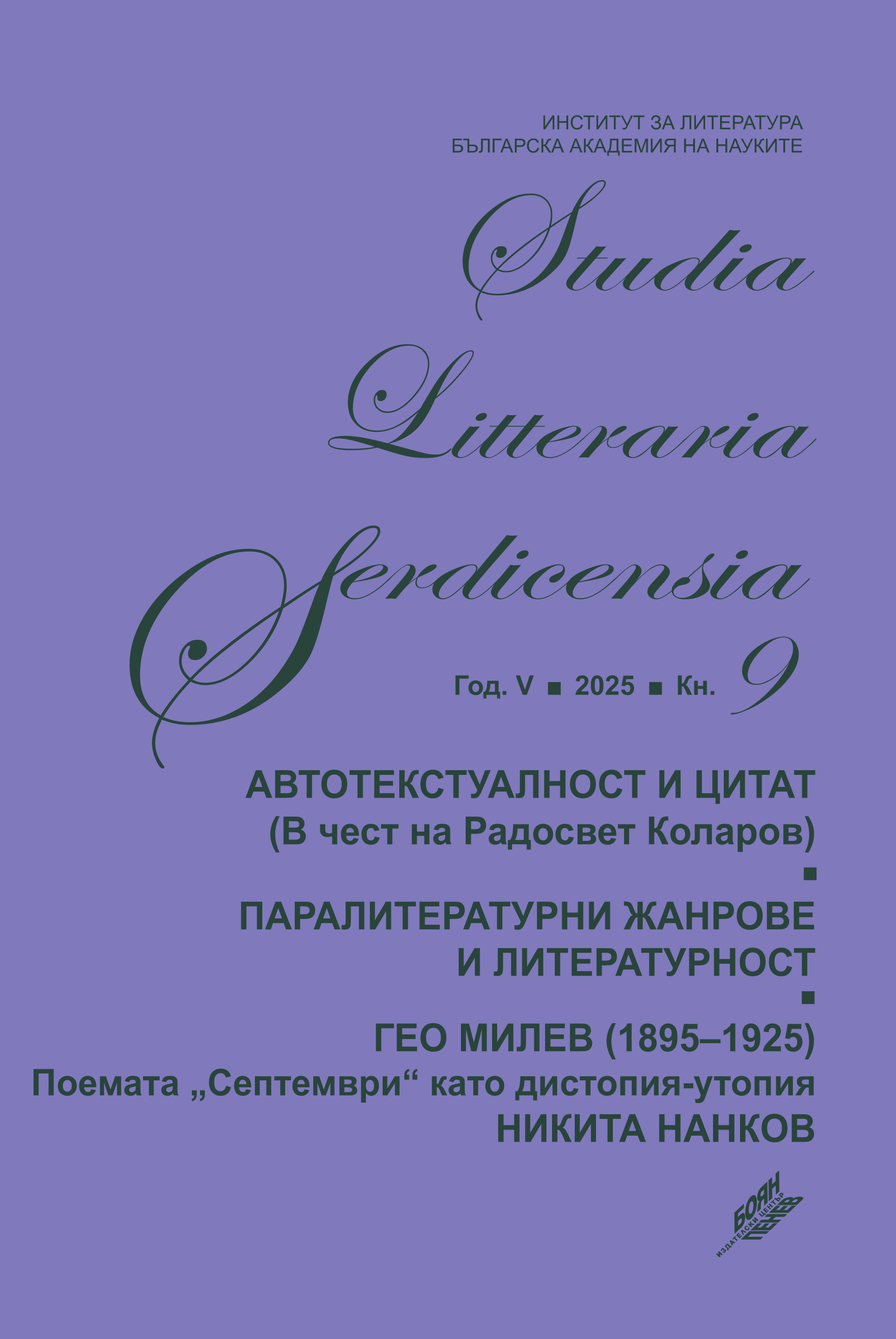
autotextuality

Autotextuality and Citation

12/04/2025

Hristo Hristov Todorov

METAPHONY AND AUTOTEXTUALITY: NOTES ON RADOSVET KOLAROV'S TERM FORMATION

  • ABSTRACT

    The paper examines two key terms in the theoretical works of the Bulgarian literary theorist Radosvet Kolarov — metaphony and autotextuality — in the immediate context of their emergence: Kolarov’s books Sound and Sense (1983) and Repetition and Creation (2009). Special attention is paid to the strategies that Kolarov follows in the process of term formation, as well as to the potential problems and limitations related to these strategies. Although Kolarov generally follows a morpheme-based minimalistic approach to his terminology, it often creates, intentionally or not, quite productive amphibolies that are helpful in charting some unstudied or neglected subfields of literary theory.


12/04/2025

Ventzeslav Scholtze, PhD

AUTOTEXTUALITY WITHOUT AN AUTHOR. THE THEORY OF AUTOTEXTUALITY AND THE EPISTEMOLOGICAL OBSTACLE OF AUTHORSHIP

  • ABSTRACT

    The paper’s aimed at elaborating and reinterpreting certain potentials of Radosvet Kolarov’s theory of autotextuality in order to revise the question of the relation between autotextual systems (idiolects) and difference, which has been mentioned and left unaddressed in “Repetition and Creation”. The paper researches the problematic of autotextual differences from the perspective of the question of the iterability of language constructs and its effects on the constitution and further interpretation of autotextual systems. Starting from that assumption, the text suggests a reading of Radosvet Kolarov’s theory as a specific deconstruction of authorship as an epistemological obstacle for the interpretation of texts framed by an author’s oeuvre.


12/04/2025

Margarita Serafimova

AUTHOR. ATMOSPHERE. AUTOTEXTUALITY

  • ABSTRACT

    On the terrain of psychology, the weather can activate involuntary memory and play the role of Proust’s madeleine. Identical meteorological circumstances are able to awaken the lost memory (“and then it was raining”). Thus memories seem to gush out of the picture of weather. The paper discusses some discursive strategies of the text (repetitions, variations, recurring motifs, disseminations) related to weather, as well as a number of more discrete intuitive or deliberate autotextual dominances and preferences for a particular season, type of weather or atmospheric phenomenon that form an invisible aura and lend a certain tonality to one’s work.


12/04/2025

Nadezhda Alexandrova

TIME, EPIGRAPH AND AUTOBIOGRAPHY: ON AUTOTEXTUALITY IN SOFRONIY VRACHANSKI

  • ABSTRACT

    The present paper deals with the autotextual potential of the codex “Book of Three Religions” written by Sofroniy Vrachanski in 1805. The main hypothesis, inspired by Radosvet Kolarov’s term “autotextuality”, is that the organization of the volume of three translated theological works on the Abrahamic religions and the original autobiography of the author correspond with a deliberately designed “epigraph”. The text of the “epigraph” is a maxim that can be regarded as a key for interpreting the whole logic of the volume. The maxim, which dates back to Antiquity coincides with Sofroniy’s idea of the different modes of time that define the role of humans as agents in global historic events.


12/04/2025

Kalin Mikhaylov

THE MOTIF OF DEATH IN THE POETICAL WORKS OF STOYAN MIHAYLOVSKI: WORLDVIEWS, INTERPRETATIVE CONTEXTS AND TRANSFORMATIONAL MECHANISMS

  • ABSTRACT

    The article considers the presence of the motif of death in the early and late poetical works of Stoyan Mihaylovski. Outlined as the main core facets of this motif, consistent in all of his works, are the general feeling of deadness associated with the death of ideals and grounds for social action in the world, and also with the perishing of all hope for the betterment of the human race; the universal scale of this calamity and the unsatisfying reasoning for “triumphant” evil in world history. The aforementioned aspects of the motif are viewed within the framework of a limited in scope whole, comprising the cycles “Doloroso” and “Varia”, from the most representative collection of Mihaylovski’s selected works to date – “Divine Rebel”, published in 1987. This makes it possible for two main and in many respects mutually exclusive world outlooks to collide and stand out, closely connected to the death motif, but oriented towards different horizons of meaning. The first one, stronger in the early Mihaylovski is the linear horizon fully contained in earthly human History with no way “upwards”, no way beyond. The second one, characteristic of the late Mihaylovski does not completely negate the first one, but integrates in itself the vertical transcendent dimension of being as well. The sonnet “Lama Sabahtani!” is seen as a key poetical work, marking the transition between the two. In the second part of the article, the death motif is viewed in a different interpretative context from the one in “Divine Rebel”. The analysis is focused on poems from another collection representative of Mihaylovski’s works, published in his lifetime and with his active participation – “Collected Works. Volume I”. The aim is to show the transformation in the death motif, using the autotextuality terms work of initiation, enhancing work and explicating work.


12/04/2025

Samuil Radilov

COLLAPSE AND INTEGRATION OF THE EPIC FORM IN THE ORDINARY PEOPLE BY GEORGI KARASLAVOV

  • ABSTRACT

    The paper aims to reveal the mechanisms of discursive disintegration in Georgi Karaslavov’s novel The Ordinary people (Obiknoveni hora, 1952–1975). According to the proposed thesis, the novel's ideological and compositional disorder is not an accidental example of the inapplicability of the social-realist method, but is due to the peculiar relationship between the individual features of the creative process and the demands of epic form as understood by the early György Lukacs. The methodological stake of this soldering is Radosvet Kolarov's concept of matrix and repetition functioning at the level of autotextuality. According to the thesis argued for here, the textual matrix that encompasses Karaslavov's work consists of two guiding principles that come into different relations according to the specific text: the principle of the documentary thought of as a marginal artistic objectivism, and the principle of the epic, thought of as an ideological treatment of the lived material. Hence the peculiarity of the epic form in the novel The Obiknoveni hora is interpreted as the result of the hypertrophy of the principle of the documentary, which seizes and thereby degenerates the epic functionality. The examples of discursive dissonance discussed serve to exemplify the consequences of the disintegration of epic form and the mechanisms of its reintegration within a post-epic structure.


12/04/2025

Ivan Georgiev

AUTOTEXTUAL LEITMOTIF TECHNIQUE. FEW ESSAYS BY THOMAS MANN (AND “DOKTOR FAUSTUS”)

  • ABSTRACT

    Thomas Mann is one of the most prominent autotextual authors who himself has commented on the key role of the leitmotif for his own work. According to the main thesis of this article, the connections between his texts is determined by a peculiar autotextual leitmotif technique. The paper elucidates what autotextual leitmotifs are and in what ways their development connects different texts of the author. The paper problematizes the boundaries between fiction and essay (in particular between the novel and the essay) of Thomas Mann through two examples of autotextual leitmotifs, the core of which is oriented towards the author's key problem of the relationship between genius and disease.


12/04/2025

Stefan Goncharov

THE TRANSMODAL CUT IN THE WORK OF J. G. BALLARD

  • ABSTRACT

    This article offers a speculative, autotextual reading of J. G. Ballard’s oeuvre through the lens of psychoanalysis and the theoretical framework of Radosvet Kolarov. It seeks to develop the concept of “auto-catastrophe” – a traumatic event that marks a radical turning point in an author’s creative output. The study conceptualizes this auto-catastrophe as a “transmodal cut” that (dis)connects various techniques, motifs, media, corpora, etc. The text also proposes a reading of Kolarov’s notion of “discursive desire,” interpreted through Jacques Lacan’s psychoanalytic concept of enjoyment [jouissance].
    The article applies these concepts in an analysis of Ballard’s most experimental work, The Atrocity Exhibition, emphasizing its intermedial aspects in order to demonstrate how the transgressive nature of the transmodal cut enables literature to cross its own formal boundaries. The text also explores how the auto-catastrophe can (dis)connect the works and enjoyments of different authors who share the same trauma. To this end, it briefly examines the relationship between the works of Ballard and those of the American writer William Burroughs.


12/04/2025

Alexander Popov

ARTIFICIAL INTELLIGENCE AS AN AUTOTEXTUAL PROCESS

  • ABSTRACT

    The Article presents a close reading of the movie “Her” (2013), directed by Spike Jonze. In that reading the artificial intelligence in the movie is modeled via the theoretical apparatus of Radosvet Kolarov introduced in his book Repetition and Creation: Poetics of Autotextuality. Twelve years after the premiere of the movie, the operating system Samantha seems like a plausible extension of current large language models, bearing in mind her full dependence on the human-derived textual data on which she has been trained. “Her”, however, goes beyond the mechanical extrapolation that artificial intelligence is going to get ever faster, more precise and defter at the manipulation of language, as it is used by people. The operating systems in the movie gradually converge on the position of being simultaneously readers, authors, editors and critics of the full corpus of texts, and perhaps ultimately achieve the virtual being of the idea, which in Kolarov’s work is tied to the concept of “matrix”, i.e. a virtual invariant of the idea that determines the autotextual transformations within the oeuvre of a given author. The artificial intelligences in “Her” implicitly work with the whole of humanity as a corpus and in this way they dynamize the boundaries between work and oeuvre, person and world, individual and archetype, body and mind, as well as other ontological binaries. Following Kolarov, the article attempts to explicitly reconstruct this model for the development of artificial intelligence, which is hidden in the movie. That model perhaps should be seen not so much as a speculative attempt at prediction, but as the hyperintensification of a phenomenology of text which is already deeply implicated in the present.