
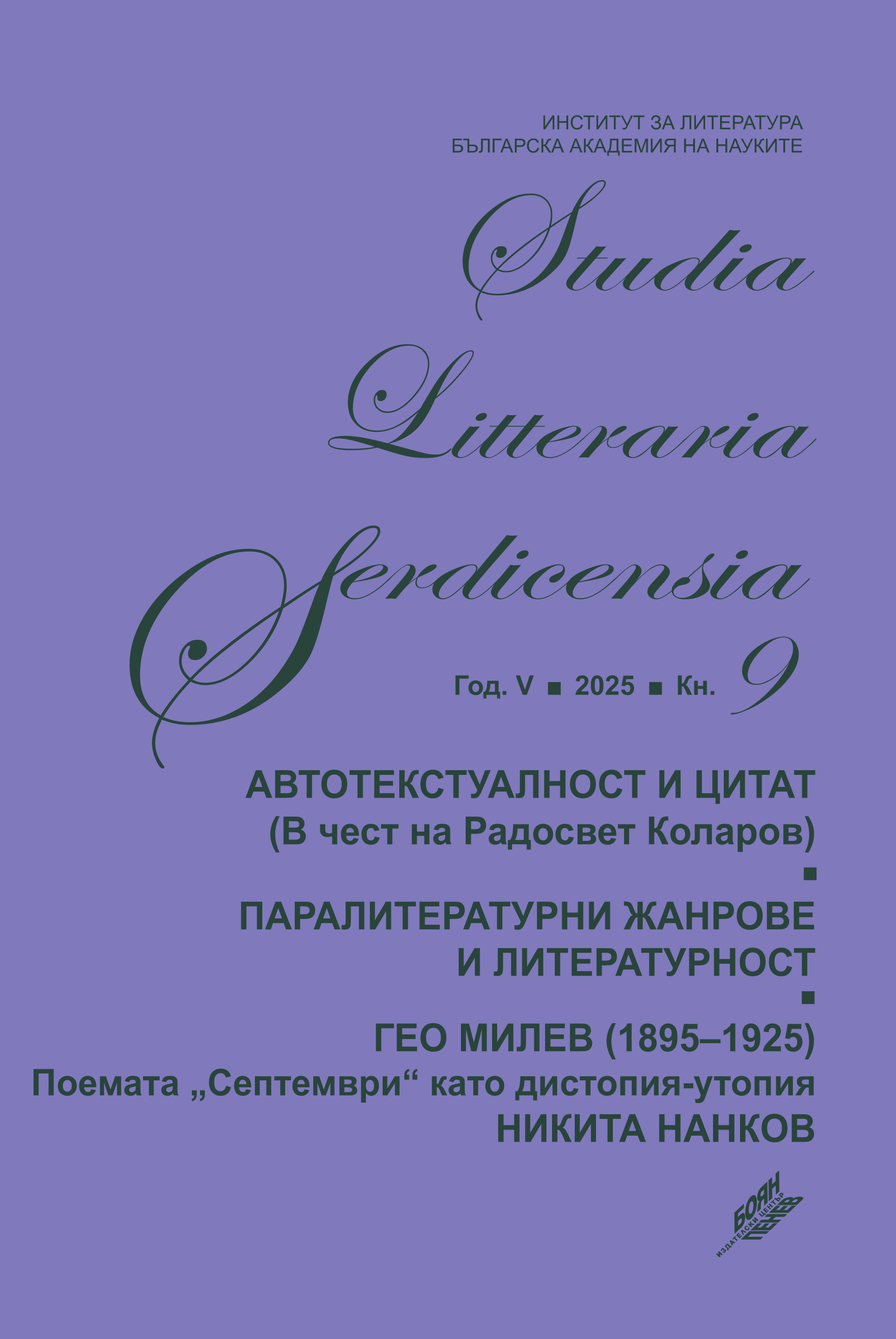
Paraliterary Genres and Literariness

12/04/2025

Nikola Stoyanov

THEORY-FICTIONS AND HYPERSTITIONS: A ROUGH INTRODUCTION

  • ABSTRACT

    The article traces the genealogy of theory-fiction—a hybrid writing practice that consciously blurs the boundaries between philosophical argument and literary narrative. It begins with the early activities of the Cybernetic Culture Research Unit (CCRU) at the University of Warwick (1995–2003), whose key figures, Nick Land and Mark Fisher, “punctured” academic discourse in order to inject elements of cyberpunk, occultism, and electronic music. Through close readings of Land, Fisher, and Reza Negarestani—especially the novel-essay Cyclonopedia—the study shows how the concept of hyperstition turns literary fiction into an instrument of actual cultural intervention.

    Part I situates James Wood’s notion of “hysterical realism” as a historical backdrop for the crystallisation of theory-fiction. Part II analyses CCRU concepts such as “Meltdown” and “spinal catastrophism,” following their passage from lecture halls into the early-2000s blogosphere (K-PUNK, Hyperstition, Xenosystems). Part III examines hyperstition itself: a mechanism by which fictional ideas—like William Burroughs’s “word-viruses” — materialise in socio-technological reality. Finally, deploying Deleuze and Guattari’s idea of “minor literature” (deterritorialized, collective, and inevitably political), the article shows how theory-fictions undermine hierarchies between “high” theory and popular culture. The conclusion defends the thesis that theory-fiction offers a model of radical writing capable of both describing and transforming reality, restoring to philosophy its status as a dangerous, “magical” practice.


12/04/2025

Ventzeslav Scholtze, PhD

NOSTALGISM OF THE IMPOSSIBLE. AN ATTEMPT FOR A PARALITERATURAL READING OF THE SOVIETWAVE GENRE


12/04/2025

Emanuela Tchitchova

THE contemporary “documentary novel” and the difficulties facing the non-fictional narrative

  • ABSTRACT

    The article explores three contemporary Bulgarian novels in order to underline the characteristics that allow us to use the genre definition “documentary novel”. Based on Philippe Lejeune’s 1975 definitions of “autobiography” and “novel”, the article analyses the identity of the three narrative persons in the novels in order to define the distance they have with the two genres. Later, other bordering genres are discussed in order to establish the space that the documentary novel occupies. Certain literary approaches used in the novels are discussed, serving to present the narrative’s fictional side. The article concludes that the documentary novel as such has its place in literature, maintaining at the same time strong bonds with extra-literary genres.


12/04/2025

Ilvie Konedareva

OBSERVING AUTOFICTION IN THE BULGARIAN PROSE OF THE 80’s OF 20th CENTURY (A BALLAD OF GEORG HENNIH – VICTOR PASKOV)

  • ABSTRACT

    The paper centers around a possible line of interpretation of literature-reality intercourse with the help of author-figure mediation. The autobiographical disposition of the latter in A ballad to Georg Hennih fictional space is what scientific lenses are set upon. Considered the opening first part of an autobiographical trilogy (followed by Germany – a dirty story, and A love story autopsy), A ballad to Georg Hennih short novel inaugurates autofiction as Victor Paskov’s literary style and means of recognition. The ballade’s world is based on a playful dialogue between fictional and real, skillfully handled by Paskov’s own maneuver of questioning author’s status in the twofold manifestation of self-revealing and being a novel’s character. The self-revealing dimension is imbued with childhood trauma thus launching the long-term journey of answering the essential question “Who am I really?”


12/04/2025

Yanitsa Radeva

Hagabula by Todor P. Todorov in the Context of Bulgarian Literature

  • ABSTRACT

    The article researches Todor P. Todorov’s novel Hagabula as a distinctive contribution to Bulgarian magical realism, combining myth, history, and global exploration. Central are two female archetypes: the witch, embodied in a young, beautiful woman whose connection to the supernatural reopens humanity’s roots, and the grandmother, familiar from Bulgarian literature as a symbol of primal time and maternal essence but also appearing as a magical figure in the literature of the 1960s and 1970s. Todorov transforms the grandmother figure into a rejuvenated, magical witch, thus bridging tradition and innovation. The article examines how the novel stages both the loss of home and the search for the new in general, positioning Hagabula simultaneously as a departure from and a continuation of the Bulgarian literary heritage of root-seeking from the previous century.


12/04/2025

Yakim Petrov

THE JESTS OF THE INFINITE: INTRODUCTION TO DAVID FOSTER WALLACE

  • ABSTRACT

    The task of “Jests of the Infinite: Introduction to David Foster Wallace” is to mark some key aspects within the thought of the contemporary author David Foster Wallace. The main goal of the article is to open a conceptual field where the texts of a little known within the local context author could be discussed, analysed and criticised.

    It is in this sense that the article is explicitly introductory and therefore limited not only to Wallace’s most famous work – the 1000+ pages maximalist novel “Infinite Jest” — but also to its title. Thus, what “Jests of the Infinite” presents is a speculative reading of the novel’s title, which is a quote from Shakespeare’s “Hamlet”. It is through this speculative reading that the article explores some of Wallace’s key ideas, themes and positions. Ideas and positions, which trace and weave together the fields of contemporary philosophy (both analytic and continental), Lacanian psychoanalysis and mathematics. So, what article еxplicates is how the mentioned fields can be found already within the title of Wallace’s maximalist novel. And furthermore, how such an explication opens the possibility for an interesting rethinking of modern culture’s constitutive tragedy (Hamlet) and also how it can ground the dynamic conceptual space for Wallace’s thought.

    Last but not least, after the explication of the title, which will focus mainly on the concepts of the “jest” and the “infinite”, the article concludes with marking a specific counter-intuitive relation between Wallace’s thought and literary project and the philosophy of Alain Badiou whose project regards the fields of psychoanalysis and mathematics as crucial for the creation of a rigorous and operative contemporary ontology